

 See My Latest Article on HelloNation
Why roof drainage deserves attention
Effective roof drainage moves rain, melting snow, and ice away from the roof, exterior walls, foundation, and walkways. A roof can be in good condition and still contribute to leaks or basement moisture if its gutters, downspouts, valleys, or surrounding grade cannot handle runoff.
For homes in Nanticoke, PA, drainage deserves attention throughout the year. Heavy summer rain, falling leaves, freeze-thaw cycles, and winter snow can each interrupt the path water is supposed to follow. Older homes, additions, porches, and tightly spaced properties may also have drainage layouts that need more frequent observation.
The goal is simple: collect water where it leaves the roof, carry it through a reliable route, and discharge it far enough away that it does not return toward the structure.
How should gutters and downspouts be arranged?
Gutters should be continuous enough to collect runoff from the roof edges without allowing water to spill behind them. They need a slight, consistent slope toward outlets, but they should not sag between fasteners. A low spot can hold water, sediment, and ice even when the rest of the gutter appears clean.
Downspouts should be placed where they can receive water from long gutter runs and roof valleys. A roof section that drains a large area may need more than one outlet. Downspouts should also be firmly attached to the wall and connected tightly to the gutter outlet.
Good drainage details include:
- Gutter sections that do not sag or pull away from the fascia
- Downspouts that are straight, secure, and free of obstructions
- Elbows that do not leak at their seams
- Extensions or splash blocks that direct discharge away from the foundation
- A clear path at the bottom of each downspout
- No discharge directed onto a walkway, stair, basement window well, or neighboring property
The outlet matters as much as the gutter. Water released directly beside the foundation can soak the soil and eventually enter through cracks, joints, window wells, or porous masonry.
How far should downspouts discharge from the house?
Downspouts should discharge far enough away that water does not collect beside the foundation. In many residential situations, an extension carrying water at least several feet away is a practical starting point, provided the ground slopes away and the outlet does not create a problem elsewhere.
The exact distance depends on the property. A home with a steep lot may need a longer, more controlled route. A flat yard may require a buried drain, drywell, swale, or another approved method of moving water. Discharging too close to a neighboring structure, sidewalk, retaining wall, or septic area can create new problems.
Watch the ground during a heavy rain. Water should not form a persistent puddle at the downspout outlet. If soil washes away, mulch floats, or a channel develops, the discharge needs better outlet protection or a different route.
What role does the ground around the house play?
Roof drainage and site drainage work together. Gutters cannot protect a home if the surrounding soil slopes toward the foundation or if settled ground creates a basin beside the walls.
The soil near the house should generally shed surface water away from the structure. Over time, backfill can settle, garden beds can become too high, and paving can shift toward the building. These changes may cause roof runoff to collect beside the foundation even when the gutters are functioning correctly.
Check for:
- Soil that has settled beneath downspout outlets
- Mulch or planting beds built above siding, trim, or masonry openings
- Cracks or gaps where paving meets the foundation
- Water flowing toward basement doors or window wells
- Erosion beneath gutter outlets
- Areas where roof runoff crosses a walkway
Adding soil directly against siding is not a permanent drainage repair. It can hide moisture damage and may allow water to reach materials that need to remain above grade.
How often should gutters and roof drainage paths be checked?
Most homes benefit from inspections at least twice each year: once after leaves have fallen and again before the heavier spring and summer rain period. Additional checks are useful after major storms, strong winds, or rapid snowmelt.
Gutters should be cleared when leaves, twigs, roofing granules, and sediment begin to restrict flow. Cleaning is not only about preventing overflow. Debris can hold moisture against metal components, add weight to the gutter, and contribute to ice buildup during freezing weather.
A ground-level inspection can reveal many problems without climbing onto the roof. Look for:
- Water stains beneath the eaves
- Gutter sections that appear twisted or separated
- Rust, holes, or open seams
- Overflow marks on siding
- Missing or loose downspout sections
- Soil erosion near discharge points
- Damp basement walls after rainfall
- Water remaining in gutters after the storm has passed

Roof drains, scuppers, and internal drainage systems on low-slope roofs require special attention. Leaves and ice can block these openings, while a small amount of ponding may be difficult to see from the ground. Standing water that remains after weather has cleared is a warning sign, not a normal feature.
What should homeowners know about valleys, edges, and flashing?
Roof valleys collect runoff from two sloping roof sections, so they handle more water than many other areas. Leaves, pine needles, and windblown debris often gather there. If a valley becomes blocked or its metal lining is damaged, water may back up beneath nearby roofing materials.
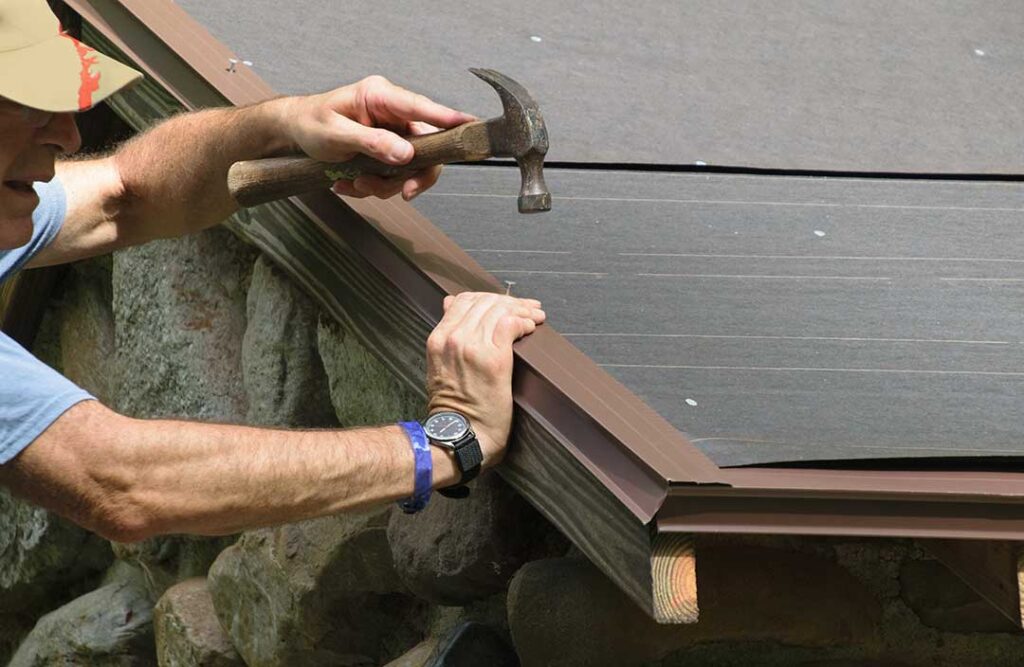
Roof edges also deserve inspection. Drip edges help guide water into the gutter instead of behind the fascia or onto the roof sheathing. Damaged or improperly placed flashing can allow water to enter around chimneys, walls, skylights, dormers, and roof-to-porch connections.
A common misconception is that a roof leak always appears directly beneath the damaged area. Water can travel along roof decking, rafters, insulation, or interior framing before becoming visible. A ceiling stain may therefore be several feet from the original drainage or flashing problem.
How do winter conditions affect roof drainage?
Freezing weather can turn minor drainage defects into larger problems. Water trapped in clogged gutters or low spots may freeze, expand, and add weight to the system. Ice can also block normal runoff, causing water to move beneath roofing materials or behind fascia.
Before winter, confirm that gutters are clear, downspouts are open, and extensions are positioned securely. Do not chip aggressively at ice on roofing or gutters, since sharp tools can damage surfaces and loosen fasteners.
Snow and ice should not be removed from a roof by walking on fragile areas or using improvised equipment. Steep roofs, icy surfaces, and overhead hazards create genuine safety risks. Conditions involving structural sagging, significant ice buildup, interior leaking, or inaccessible drainage components may require qualified assistance rather than risky do-it-yourself work.
Can a drainage problem be fixed by adding larger gutters?
Not always. Larger gutters may help a roof that receives concentrated runoff, but size alone does not solve poor slope, inadequate downspout capacity, clogged outlets, incorrect flashing, or ground that drains toward the house.
A complete evaluation considers the roof area, pitch, valley layout, gutter slope, number of downspouts, outlet locations, and discharge route. In some cases, adding a downspout is more effective than replacing the entire gutter system. In others, the underlying issue is a settled foundation-side grade or a damaged roof edge.
The most reliable approach is to follow the entire path of water during or immediately after rainfall: roof surface, valley, edge, gutter, downspout, outlet, and surrounding ground. The point where water stops moving freely is often the starting point for the repair.
When does roof drainage need urgent attention?
Prompt attention is warranted when water enters living areas, gutters pull away from the building, roof sections sag, water ponds repeatedly, or a downspout discharges against the foundation. Interior bubbling paint, damp insulation, musty odors, and recurring basement moisture can also indicate that roof runoff is not being controlled.
Routine maintenance can prevent many drainage problems, but hazardous roof access, suspected structural damage, and persistent water entry should not be handled with unsafe climbing or temporary patching alone. A drainage system works best when every component—from roof edge to soil surface—supports the same basic objective: move water away from the building and keep it moving.